
Explore Agentic AI services by AJUPY AI, including custom AI agents, multi-agent systems, intelligent workflow automation, enterprise AI integration, and business process automation.
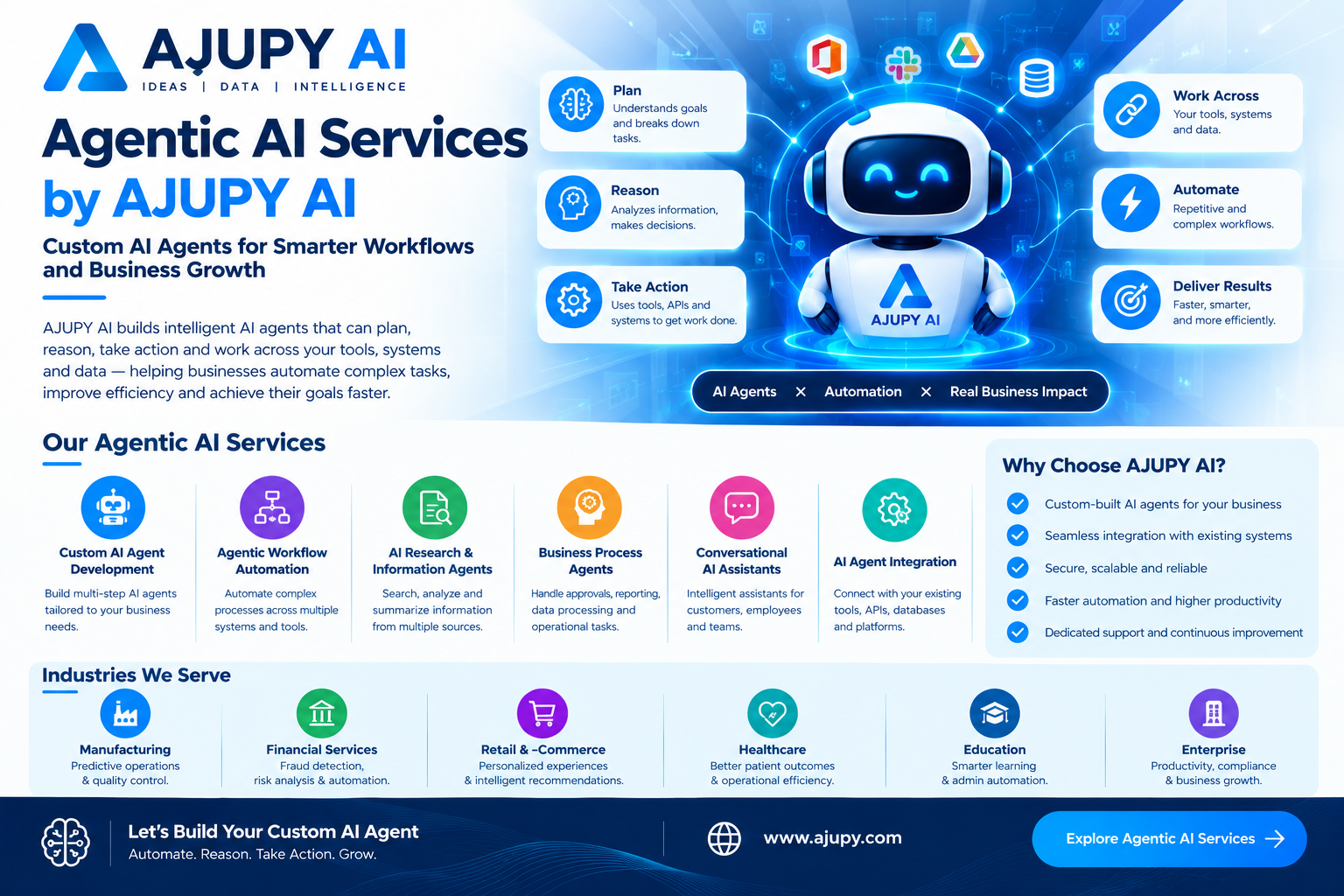
Agentic AI Services by AJUPY AI | Custom AI Agents
Intelligent AI Agents That Plan, Reason, Execute, and Automate Business Workflows
Agentic AI Services by AJUPY AI
Intelligent AI Agents That Plan, Reason, Execute, and Automate Business Workflows
AJUPY AI provides Agentic AI solutions designed to help businesses develop intelligent AI agents, automate complex workflows, connect business applications, and improve operational productivity.
Agentic AI represents an important development in artificial intelligence. Instead of simply generating responses to user prompts, agentic systems can be designed to pursue specific objectives, break tasks into steps, use approved tools, retrieve information, and execute multi-stage workflows with varying degrees of autonomy.
AJUPY AI focuses on Agentic AI development, custom AI agents, multi-agent systems, intelligent business automation, AI-powered applications, and enterprise AI integration.
Our goal is to help startups, small businesses, enterprises, manufacturers, e-commerce companies, and technology organizations explore how intelligent agents can support real-world business operations.
From AI customer support agents and sales assistants to research agents, business process automation, and custom AI software, AJUPY AI helps organizations explore the next generation of intelligent digital solutions.
AJUPY AI — Intelligent Agents. Autonomous Workflows. Smarter Business Operations.
Official Website: AJUPY AI
Email: info@ajupy.com
1. What Is Agentic AI?
Agentic AI refers to artificial intelligence systems designed to work toward defined objectives by combining capabilities such as planning, reasoning, tool use, information retrieval, and multi-step task execution.
Traditional automation generally follows predefined rules. A conventional chatbot primarily responds to user questions. An Agentic AI system can be designed to go further by selecting actions, interacting with compatible applications, checking results, and continuing through a workflow until it reaches a defined stopping condition.
For example, a business research agent could receive a research objective, collect information from approved sources, organize relevant findings, prepare a report, and submit the report for human review.
Agentic AI does not necessarily mean completely autonomous operation. Its capabilities depend on the underlying AI model, available tools, system instructions, permissions, and safeguards.
AJUPY AI Agentic AI Services Include
- Custom AI agent development.
- Autonomous and semi-autonomous AI workflows.
- Multi-agent AI system development.
- Business process automation.
- AI-powered customer support agents.
- Sales and marketing agents.
- AI research and data analysis agents.
- Enterprise AI assistants.
- AI workflow orchestration.
- API and software integration.
- Custom AI application development.
- Intelligent decision-support systems.
These solutions can help organizations identify opportunities to reduce repetitive work, improve information processing, and streamline business operations.
2. Custom AI Agent Development Services
Build AI Agents for Your Business
Every business has unique workflows, systems, and operational requirements. Custom AI agents can be designed around those specific needs.
AJUPY AI’s Agentic AI service offering focuses on developing specialized agents for defined tasks, integrating them with compatible tools, and incorporating appropriate controls for reliable operation.
Types of Custom AI Agents
Business Operations Agents
Assist with routine administrative workflows, task coordination, information processing, and operational reporting.
Research Agents
Gather information from approved sources, organize findings, compare information, and prepare research summaries.
Customer Support Agents
Respond to common customer questions, retrieve relevant information, classify support requests, and route complex cases to human representatives.
Sales Agents
Assist with lead research, prospect classification, sales preparation, customer communication drafts, and follow-up workflows.
Marketing Agents
Support campaign planning, content preparation, market research, and marketing performance summaries.
Data Analysis Agents
Help examine authorized datasets, summarize information, identify patterns, and prepare reports for review.
HR Support Agents
Assist with internal policy questions, employee information retrieval, onboarding documentation, and administrative workflows, subject to appropriate access controls.
Software Development Agents
Support selected software development tasks, including code explanation, test preparation, documentation, and development workflow assistance.
Industry-Specific Agents
Develop specialized AI agents around the needs of industries such as manufacturing, retail, education, fashion, real estate, and technology.
Benefits of Custom AI Agents
- Tailored workflows for specific business objectives.
- Integration with compatible software systems.
- Reduced repetitive information-processing work.
- More organized task execution.
- Improved access to relevant business information.
- Better coordination between AI tools and human teams.
- Greater flexibility than one-size-fits-all automation.
The exact capabilities of each agent depend on its design, connected systems, and permitted actions.
3. Autonomous AI Agents and Intelligent Task Execution
Move Beyond Simple Chatbots
An AI agent can be designed to execute a sequence of tasks rather than stopping after generating a single response.
AJUPY AI explores autonomous and semi-autonomous AI workflows that combine planning, tool use, information retrieval, and validation.
Key Capabilities
Goal-Oriented Execution
The system receives a defined objective and works through the steps required to address it.
Task Planning
The agent breaks a complex objective into smaller, manageable tasks.
Context Gathering
The agent retrieves relevant information from authorized sources and connected applications.
Tool Usage
The agent uses permitted tools, APIs, and software functions to perform specific actions.
Result Validation
The system checks whether outputs satisfy defined conditions and identifies missing or inconsistent information.
Exception Handling
When a task cannot be completed reliably, the workflow can stop, request clarification, or escalate to a human.
Progress Reporting
The system can record completed steps, outstanding actions, and results.
Example: AI Business Research Agent
Imagine a company wants to research a new market.
An appropriately configured AI research agent could:
- Receive the research objective.
- Identify relevant research questions.
- Retrieve information from approved sources.
- Organize findings into relevant categories.
- Compare available information.
- Identify gaps or conflicting evidence.
- Prepare a structured research report.
- Provide source references where supported.
- Submit the report for human verification.
This workflow can accelerate research preparation, although the reliability of its conclusions depends on source quality, model capabilities, and validation.
4. Multi-Agent AI System Development
Multiple Specialized Agents Working Together
A multi-agent AI system uses multiple agents with different responsibilities to address a larger objective.
Rather than assigning every task to one general-purpose agent, a multi-agent architecture can divide work between specialized components.
AJUPY AI explores multi-agent system design for business workflows that benefit from task separation, coordination, and validation.
Example: Multi-Agent Business Workflow
A business intelligence workflow could include the following agents:
Research Agent: Collects information from approved sources.
Data Analysis Agent: Examines structured information and identifies relevant patterns.
Content Agent: Prepares a report based on the research and analysis.
Validation Agent: Checks whether the report meets defined requirements and identifies unsupported claims.
Coordinator Agent: Manages task progression and collects the outputs.
Human Reviewer: Approves the final report before distribution.
Multi-Agent AI Applications
- Business research and analysis.
- Marketing campaign preparation.
- Customer support coordination.
- Document processing.
- Software development assistance.
- Enterprise knowledge management.
- Workflow monitoring.
- Business reporting.
- Supply chain information processing.
- Industry-specific automation.
Multi-agent systems can introduce additional complexity, latency, and cost. They should be used when the benefits of task specialization justify the extra coordination.
5. AI Workflow Automation Services
Connect Intelligent Agents to Business Processes
Agentic AI becomes particularly useful when integrated into existing workflows.
AJUPY AI combines its Agentic AI service offering with intelligent workflow automation to help organizations explore how tasks can move between AI models, software applications, databases, and human teams.
Workflow Automation Capabilities
- Multi-step task orchestration.
- Automated information processing.
- API-based application integration.
- Document classification and extraction.
- Task assignment and routing.
- AI-generated report preparation.
- Automated notifications.
- Approval-based workflows.
- Exception detection and escalation.
- Workflow monitoring and reporting.
Example: Automated Customer Inquiry Workflow
A customer submits an inquiry through a website.
An AI-powered workflow could:
- Receive the inquiry.
- Identify the customer’s request.
- Retrieve relevant information from an approved knowledge base.
- Draft an appropriate response.
- Determine whether the inquiry needs specialist attention.
- Route the request to the relevant team.
- Request approval for sensitive responses.
- Record the outcome in a compatible customer management system.
This approach can reduce manual handling and improve workflow consistency when the integrations and AI components are appropriately configured.
6. AI Sales and Marketing Agents
Intelligent Assistance for Customer Acquisition and Marketing Operations
Sales and marketing teams handle research, lead management, customer communication, campaign planning, and performance reporting.
AI agents can assist with selected parts of these processes, allowing employees to focus on strategy, customer relationships, and important decisions.
AI Sales Agent Services
- Lead research using approved sources.
- Lead classification and prioritization.
- Prospect information summarization.
- Sales email drafting.
- Customer inquiry categorization.
- Follow-up task preparation.
- CRM data entry assistance.
- Sales report generation.
- Meeting preparation.
- Customer communication workflows.
AI Marketing Agent Services
- Marketing research.
- Campaign planning assistance.
- SEO content preparation.
- Social media content drafts.
- Product description generation.
- Competitor information analysis.
- Content performance summaries.
- Campaign reporting.
- Content workflow coordination.
Example: AI-Assisted Lead Management
An AI sales workflow could receive a new lead, organize the submitted information, classify the inquiry, prepare a personalized draft response, and assign the lead to an appropriate salesperson.
Sending external messages, modifying sensitive records, or making consequential business commitments should require suitable permissions and approval controls.
7. AI Customer Support Agents and Virtual Assistants
Improve Customer Support with Intelligent AI
AI customer support agents can help businesses answer common questions, retrieve product information, organize incoming requests, and direct customers to the right resources.
AJUPY AI explores customer-facing and internal AI assistant solutions based on business requirements.
Customer Support Capabilities
- Website AI support agents.
- Product information assistants.
- Knowledge-base search.
- FAQ automation.
- Support request classification.
- Ticket routing.
- Response drafting.
- Customer inquiry summarization.
- Multilingual interactions where supported.
- Human-agent escalation.
Internal AI Assistants
AI assistants can also help employees retrieve approved information from internal documentation, policies, product guides, and knowledge bases.
For enterprise use, these systems should respect user permissions and protect confidential information.
The objective is not simply to automate every conversation. It is to provide useful assistance while ensuring that complex, sensitive, or uncertain cases receive appropriate human attention.
8. AI Research, Data Analysis, and Business Intelligence Agents
Transform Information into Actionable Business Insights
Organizations generate information across reports, databases, documents, customer interactions, and operational systems.
AI agents can help retrieve, organize, analyze, and summarize this information.
AI Research Services
- Research workflow automation.
- Information gathering from approved sources.
- Document summarization.
- Research report preparation.
- Source comparison.
- Information classification.
- Knowledge discovery.
AI Data Analysis Services
- Dataset exploration.
- Data summarization.
- Natural-language data querying.
- Business report preparation.
- Pattern identification.
- Anomaly flagging.
- Visualization workflow assistance.
- Automated reporting.
Example: AI Reporting Agent
A reporting agent could retrieve authorized operational data, calculate specified metrics using appropriate tools, prepare a summary, identify missing information, and generate a report for review.
Numerical calculations should use reliable computational methods where appropriate rather than relying solely on language-model predictions.
9. Enterprise Agentic AI Solutions
Intelligent AI Systems for Business Transformation
Enterprises often require AI systems that integrate with existing applications, support multiple teams, and operate within clearly defined security and governance requirements.
AJUPY AI’s enterprise AI service offering includes Agentic AI and automation use cases designed around organizational workflows.
Enterprise AI Applications
Enterprise Knowledge Assistants
Help employees retrieve information from authorized documents and internal knowledge sources.
Operations Agents
Assist with administrative coordination, reporting, and recurring operational tasks.
Document Processing Agents
Extract, classify, summarize, and validate information from supported documents.
Customer Experience Agents
Assist customer service teams with inquiries, knowledge retrieval, and request routing.
Business Reporting Agents
Prepare summaries and reports from authorized business information.
Application Integration Agents
Interact with compatible software systems through approved APIs and tools.
Department-Specific AI Assistants
Develop AI assistance for defined departmental requirements, subject to access permissions and workflow controls.
Enterprise Implementation Considerations
- Authentication and authorization.
- Role-based access control.
- Secure API credential management.
- Data access restrictions.
- Audit logging.
- Workflow monitoring.
- Output evaluation.
- Human approval.
- Error handling.
- Cost and performance management.
Enterprise AI should be designed around the organization’s real security, operational, and compliance requirements.
10. AI Agents for E-commerce and Retail
Automate Digital Commerce Workflows
E-commerce businesses manage product catalogs, customer inquiries, order information, marketing campaigns, and operational reporting.
AI agents can help coordinate these activities when appropriate integrations are available.
E-commerce Agent Applications
- Product information assistants.
- Catalog classification workflows.
- Product description preparation.
- Customer support automation.
- Order inquiry routing.
- Customer feedback summarization.
- Marketing content preparation.
- Inventory information retrieval.
- Sales reporting.
- Product discovery assistance.
For example, an e-commerce support agent could retrieve approved product details, answer common questions, and route order-related issues to the correct team.
Actions involving refunds, payments, order changes, or sensitive customer data should require suitable authorization and verification.
11. AI Agents for Manufacturing and Operations
Intelligent Automation for Industrial Workflows
Manufacturing and industrial organizations often manage complex processes involving production information, inventory, maintenance records, quality documentation, and supply chain coordination.
AI agents can assist with selected information-intensive activities.
Potential Manufacturing Applications
Production Reporting Agents
Summarize authorized production data and prepare operational reports.
Maintenance Information Agents
Retrieve maintenance documentation, summarize service histories, and assist with maintenance planning.
Quality Documentation Agents
Organize inspection records, summarize findings, and flag missing documentation.
Inventory Support Agents
Retrieve stock information and assist with inventory reporting.
Supply Chain Research Agents
Organize supplier information, summarize available data, and assist with planning workflows.
Process Documentation Agents
Generate draft standard operating procedures and organize technical documentation for review.
Industrial systems that affect machinery, physical safety, or production controls require appropriate engineering validation and human oversight. An AI agent should not be given unrestricted control over safety-critical equipment.
12. AI Agents for Software Development
Accelerate Software Engineering with Intelligent Agents
AI agents can support selected stages of the software development lifecycle.
AJUPY AI explores AI-powered software workflows that combine language models with development tools and controlled execution environments.
Software Development Agent Applications
- Code explanation.
- Code generation assistance.
- Documentation preparation.
- Test case generation.
- Bug investigation assistance.
- Code review support.
- Repository information retrieval.
- Development task planning.
- Test execution through approved tools.
- Deployment workflow assistance.
Example: AI-Assisted Development Workflow
A development agent could receive a clearly defined task, inspect authorized project files, suggest a code change, generate tests, run permitted checks, and prepare a summary for a developer to review.
Generated code must be tested and reviewed. Repository access, execution permissions, and deployment approvals should be carefully controlled.
13. AI Agents for HR and Administrative Operations
Streamline Internal Business Workflows
Human resources and administrative teams handle recurring questions, documentation, onboarding, scheduling, and internal coordination.
AI agents can assist with these activities when the relevant information is available and appropriate permissions are configured.
Potential Applications
- Employee policy assistants.
- Onboarding document preparation.
- HR inquiry classification.
- Training resource retrieval.
- Internal document summarization.
- Meeting preparation.
- Task coordination.
- Administrative reporting.
- Recruitment workflow assistance.
AI should not make high-impact employment decisions without appropriate human oversight, evaluation, and compliance review.
14. AI Agents, RAG, and Enterprise Knowledge Retrieval
Ground AI Responses in Relevant Business Information
Retrieval-Augmented Generation, or RAG, combines information retrieval with generative AI.
A RAG-powered agent can retrieve relevant information from configured knowledge sources and use it to answer questions or complete supported tasks.
AJUPY AI can help organizations explore agentic workflows that combine knowledge retrieval, tool use, and controlled task execution.
Knowledge Agent Capabilities
- Search approved company documents.
- Retrieve relevant policies and procedures.
- Answer questions about product documentation.
- Summarize technical information.
- Locate relevant records.
- Prepare document-based reports.
- Cite sources where supported.
- Escalate questions when reliable information is unavailable.
How an Agentic RAG Workflow Works
- A user submits a request.
- The system identifies the relevant information required.
- The agent retrieves content from authorized sources.
- The AI model interprets the retrieved information.
- The agent uses approved tools if additional steps are needed.
- The system validates the result against defined requirements.
- The response is returned with supporting references where available.
Appropriate access controls are essential to prevent unauthorized retrieval of confidential company information.
15. AI API Integration and Agent Tool Development
Connect AI Agents to Real Business Applications
AI agents become more useful when they can interact with authorized software systems.
AJUPY AI explores integration services that connect AI applications to compatible APIs, databases, websites, and workflow platforms.
Integration Capabilities
- AI model APIs.
- Custom REST API integration.
- Database connectivity.
- CRM integration.
- E-commerce platform integration.
- Document management integration.
- Workflow orchestration.
- Authentication integration.
- Business dashboard integration.
- Monitoring and reporting tools.
Technologies That May Support Implementation
Depending on project requirements, a solution may use:
- Python.
- FastAPI.
- JavaScript and TypeScript.
- Node.js.
- React.
- Large language model APIs.
- Agent orchestration frameworks.
- Vector databases and retrieval systems.
- Cloud infrastructure.
- Conventional automation tools.
Technology selection should be based on the required capabilities, integration complexity, performance, security, and maintainability.
16. Agentic AI Security, Governance, and Reliability
Intelligent Automation with Appropriate Controls
AI agents may interact with external systems, process sensitive information, or execute actions on behalf of users. Their permissions and behavior therefore require careful design.
AJUPY AI’s Agentic AI implementations should consider appropriate safeguards based on the application and the consequences of errors.
Important Security and Governance Practices
Identity and Access Management
Ensure that agents and users can access only the resources they are authorized to use.
Permission-Limited Tool Access
Restrict each agent to the actions required for its assigned role.
Human Approval
Require authorization for sensitive actions such as sending important communications, changing records, or initiating financial transactions.
Input and Output Validation
Check data and generated outputs against defined requirements.
Audit Trails
Record relevant actions, tool calls, approvals, and workflow outcomes where appropriate.
Monitoring and Evaluation
Test performance, identify failure patterns, and monitor operational behavior.
Error Handling
Define what happens when an agent receives ambiguous instructions, encounters a failed integration, or cannot verify a result.
Secure Credential Management
Protect API keys, tokens, and other sensitive credentials.
Data Protection
Respect applicable privacy requirements and organizational data-handling policies.
The goal is to build useful AI systems without granting them unnecessary access or assuming that every AI-generated decision is correct.
17. AJUPY AI and AGI-Oriented Innovation
Preparing for the Evolution of Intelligent Systems
Artificial General Intelligence, commonly called AGI, generally refers to a proposed form of AI capable of performing a broad range of intellectual tasks with generality comparable to human capabilities. Definitions and criteria for AGI vary, and there is no universally accepted test for establishing that AGI has been achieved.
Agentic AI is not the same as AGI. An agent can plan and execute multi-step tasks within a defined environment without possessing general intelligence across all domains.
However, advances in reasoning, tool use, multimodal AI, planning, and workflow orchestration are relevant to the broader development of more capable intelligent systems.
AJUPY AI’s AGI-Oriented Technology Approach
Goal-Oriented AI
Design agents to work toward explicit objectives and measurable task outcomes.
Context-Aware Processing
Use relevant information from approved sources to support better task execution.
Multimodal AI Integration
Explore systems that process combinations of text, images, documents, and other supported inputs.
Tool-Using Agents
Connect models to authorized applications and tools through controlled interfaces.
Multi-Agent Coordination
Organize specialized agents around different responsibilities where this approach is beneficial.
Evaluation and Improvement
Assess task success, reliability, output quality, and system performance.
Human-AI Collaboration
Combine AI capabilities with human judgment, oversight, and accountability.
These principles can help organizations explore increasingly capable AI workflows while maintaining realistic expectations about current technologies.
18. Why Choose AJUPY AI for Agentic AI Services?
AJUPY AI positions its technology offering around Agentic AI, Generative AI, enterprise solutions, custom AI development, and business automation.
Our Service Focus
- Custom AI agent development.
- Intelligent workflow automation.
- Agentic AI application integration.
- Multi-agent system design.
- Enterprise knowledge assistants.
- AI-powered customer support.
- Sales and marketing automation.
- Custom AI software development.
- Business process optimization.
- Responsible AI implementation.
Our objective is to help businesses identify practical opportunities for AI and develop solutions aligned with their operational requirements.
Specific features, integrations, security controls, implementation schedules, and support arrangements depend on the agreed project scope.
19. Industries That Can Benefit from AJUPY AI Agentic AI
AJUPY AI’s Agentic AI service offering can address potential use cases across different sectors.
Manufacturing: Operational reporting, maintenance information, documentation, and inventory support.
Retail and E-commerce: Product information, customer support, catalog workflows, and sales reporting.
Education: Knowledge assistants, document retrieval, and administrative workflow support.
Fashion and Design: Creative research, content preparation, and fashion-related AI application workflows.
Real Estate: Property information organization, customer inquiry classification, and report preparation.
Marketing and Advertising: Campaign preparation, research, content workflows, and reporting.
Technology: Software development assistance, documentation, testing support, and API integration.
Professional Services: Document summarization, research, task coordination, and knowledge retrieval.
Each application should be evaluated for technical feasibility, data availability, security, expected business value, and operational risk.
20. AJUPY AI Agentic AI Development Process
From Business Requirements to Intelligent Agents
A structured development process helps ensure that AI agents solve defined problems rather than adding unnecessary complexity.
Step 1: Business Discovery
Understand the current workflow, business objectives, users, systems, and operational challenges.
Step 2: Use-Case Selection
Identify tasks that are suitable for AI assistance or automation and distinguish them from tasks requiring conventional software logic or human judgment.
Step 3: Agent Architecture
Determine the agent’s responsibilities, permitted tools, data sources, execution limits, and escalation requirements.
Step 4: Prototype Development
Develop a proof of concept to evaluate whether the proposed solution can perform the intended tasks.
Step 5: Integration
Connect approved APIs, databases, knowledge sources, and applications.
Step 6: Testing and Evaluation
Test task completion, output quality, error handling, permissions, security, and performance.
Step 7: Deployment
Deploy the solution into an appropriate environment with the required access controls and monitoring.
Step 8: Monitoring and Optimization
Review actual performance, investigate failures, and refine workflows as business requirements evolve.
Project scope, timelines, and deployment arrangements depend on the specific use case.
21. Frequently Asked Questions About AJUPY AI Agentic AI Services
What are Agentic AI services?
Agentic AI services involve designing, developing, integrating, and evaluating AI systems that can pursue defined objectives through planning, tool use, and multi-step task execution.
Does AJUPY AI provide Agentic AI services?
AJUPY AI presents Agentic AI systems, custom AI agents, enterprise AI integration, and intelligent automation among its AI service offerings. You can explore its official service information at AJUPY AI Services.
What types of AI agents can AJUPY AI help develop?
Potential applications include business operations agents, research assistants, customer support agents, sales and marketing agents, document-processing agents, and specialized enterprise assistants.
What is the difference between Agentic AI and Generative AI?
Generative AI focuses on creating outputs such as text, images, and code. Agentic AI focuses on systems that pursue defined objectives through planning, tool use, and sequences of actions. An agent may use a generative model as part of its operation.
Can AI agents automate complete business workflows?
AI agents can be designed to manage multiple steps in a workflow when the necessary tools and integrations are available. Sensitive or consequential steps may require human approval.
What is a multi-agent AI system?
A multi-agent system contains multiple AI agents with different responsibilities that coordinate to accomplish a broader objective.
Can AI agents connect to existing business software?
Yes. Compatible agents can connect to APIs, databases, and business applications, subject to technical feasibility, access permissions, and security requirements.
Can small businesses use Agentic AI?
Yes. Small businesses can explore agents for customer inquiry handling, document processing, research, reporting, and other clearly defined workflows.
Is Agentic AI the same as AGI?
No. Agentic AI describes systems that pursue defined objectives through actions and tool use. AGI is a broader concept involving general intelligence across a wide range of intellectual tasks.
Are AI agents completely autonomous?
Not necessarily. An agent’s autonomy depends on its design, permissions, connected tools, and safeguards. Some systems require human approval for important actions.
How can I contact AJUPY AI?
For inquiries about Agentic AI, custom AI agents, business automation, and AI application development, contact:
Email: info@ajupy.com
Website: https://ajupy.com
22. Build Intelligent AI Agents with AJUPY AI
The evolution of artificial intelligence is creating new opportunities to automate business workflows, connect software systems, improve information access, and develop intelligent digital products.
Agentic AI enables organizations to explore systems that can plan tasks, use approved tools, coordinate workflows, and assist with complex operational activities.
AJUPY AI focuses on helping businesses explore these opportunities through custom AI agent development, multi-agent architectures, enterprise AI solutions, and intelligent workflow automation.
Whether you want to build a customer support agent, automate a business process, develop an AI research assistant, or integrate intelligent agents into an existing application, the first step is to define the business objective and identify the right technical approach.
Ready to Explore Agentic AI for Your Business?
Contact AJUPY AI to discuss your requirements and explore potential AI solutions.
Email: info@ajupy.com
Website: Visit AJUPY AI
AJUPY AI
Agentic AI That Plans, Acts, and Automates.
Build Intelligent Agents. Connect Your Workflows. Transform Your Business.