
AJUPY AI provides Custom Machine Learning and Predictive AI solutions to help businesses analyze historical data, identify patterns, forecast future outcomes, detect unusual activity, and deliver more relevant recommendations.
Turn Business Data into Predictions, Intelligent Decisions, and Measurable Opportunities
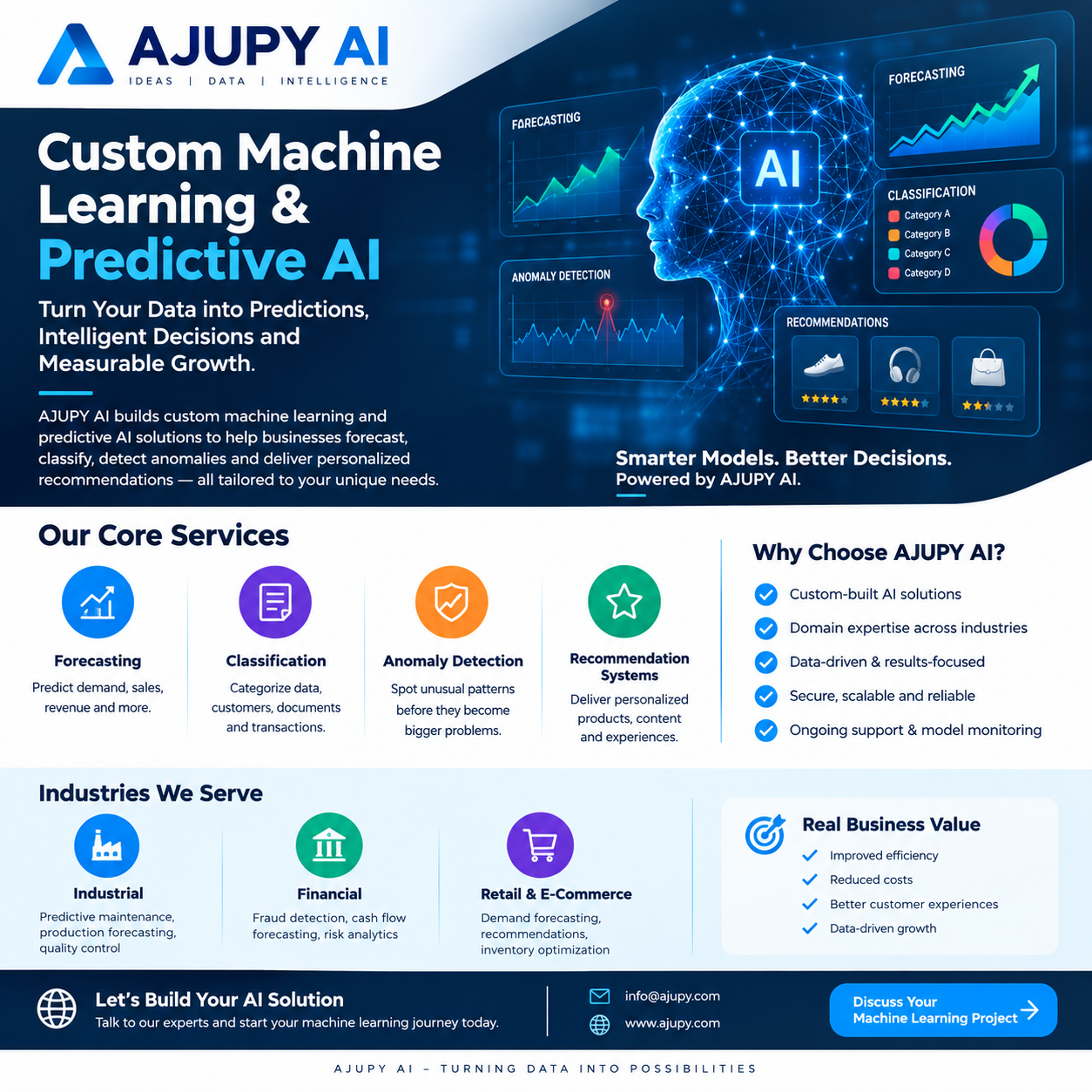
Custom Machine Learning & Predictive AI | AJUPY AI
AJUPY AI provides Custom Machine Learning and Predictive AI solutions to help businesses analyze historical data, identify patterns, forecast future outcomes, detect unusual activity, and deliver more relevant recommendations.
AJUPY AI provides Custom Machine Learning and Predictive AI solutions to help businesses analyze historical data, identify patterns, forecast future outcomes, detect unusual activity, and deliver more relevant recommendations.
Modern organizations generate large amounts of data through transactions, customer interactions, websites, applications, production systems, inventory platforms, and business operations. When analyzed effectively, this information can help organizations understand what has happened, identify emerging trends, and make better-informed decisions about what may happen next.
Custom Machine Learning enables businesses to develop predictive models tailored to their specific data, objectives, and operating environments.
AJUPY AI focuses on developing and integrating AI-powered applications that can support forecasting, classification, anomaly detection, recommendation systems, and intelligent data analysis.
Our solutions can be designed for industrial operations, financial services, retail and e-commerce, logistics, manufacturing, technology companies, and other data-driven industries.
Explore how machine learning can support your business with AJUPY AI.
Website: https://ajupy.com
Email: info@ajupy.com
1. What Is Custom Machine Learning & Predictive AI?
Custom Machine Learning is the development or adaptation of machine-learning models to solve specific business problems using relevant data.
Predictive AI uses patterns learned from historical and other relevant data to estimate future outcomes or the likelihood of particular events.
For example, a retailer might use machine learning to forecast product demand. A manufacturer might estimate when equipment is likely to require maintenance. An e-commerce platform might recommend products based on customer preferences and interactions.
Instead of relying exclusively on generic analytics tools, organizations can develop models suited to their data, business rules, and operational requirements.
Custom Machine Learning and Predictive AI can support:
- Demand and sales forecasting
- Customer and transaction classification
- Anomaly and outlier detection
- Product and content recommendation
- Predictive maintenance
- Customer behavior analysis
- Inventory optimization
- Fraud-risk identification
- Customer churn prediction
- Quality analysis
- Operational forecasting
- Intelligent business decision support
The appropriate solution depends on the business problem, data quality, model performance, operational constraints, and the consequences of incorrect predictions.
2. Custom Forecasting Solutions
Predict Future Demand, Sales, Inventory, and Business Activity
Forecasting uses historical observations and relevant explanatory variables to estimate future values or trends.
Businesses can use forecasting models to plan inventory, allocate resources, anticipate demand, and understand potential changes in business activity.
AJUPY AI can help organizations explore customized forecasting systems based on their available data and operational needs.
A. Sales Forecasting
Sales forecasting estimates future sales using historical transactions and relevant business factors.
Potential applications include:
- Daily, weekly, and monthly sales forecasts
- Product-level sales estimates
- Regional sales forecasting
- Seasonal demand analysis
- Revenue planning support
- Sales trend identification
- Comparison of forecast and actual performance
Example: A retail company can use historical sales, promotions, seasonal patterns, and product availability to estimate demand for the coming weeks.
B. Demand Forecasting
Demand forecasting estimates the future quantity of products or services customers may require.
Potential applications include:
- Product demand prediction
- Warehouse replenishment planning
- Seasonal inventory preparation
- Distribution planning
- Demand variability analysis
- Stockout-risk estimation
Accurate forecasts can support planning, but results depend on data quality, changes in customer behavior, supply constraints, and unexpected market conditions.
C. Financial Forecasting
Machine learning can support selected financial planning and forecasting tasks.
Potential applications include:
- Cash-flow forecasting
- Expense forecasting
- Revenue projections
- Budget variance analysis
- Payment-volume prediction
- Financial trend analysis
Financial forecasts should be validated against appropriate accounting data and business assumptions. They are estimates, not guarantees of future financial performance.
D. Industrial Forecasting
Manufacturers and industrial businesses can use forecasting models to estimate future operational requirements.
Potential applications include:
- Production-volume forecasting
- Raw-material demand estimation
- Energy-consumption forecasting
- Equipment-utilization forecasting
- Maintenance workload planning
- Production bottleneck analysis
E. Time-Series Forecasting
Time-series forecasting analyzes observations collected over time to estimate future values.
Depending on the dataset, solutions may use statistical forecasting, machine learning, deep learning, or combinations of these methods.
Potential inputs include:
- Historical measurements
- Sales and transaction records
- Product prices
- Seasonal indicators
- Weather data, where relevant
- Promotion schedules
- Operational sensor measurements
- External business indicators
How AJUPY AI Can Approach Forecasting Projects
A forecasting project may include:
- Understanding the business objective and forecast horizon.
- Assessing historical data quality and availability.
- Identifying seasonal patterns, trends, and relevant variables.
- Establishing a baseline forecasting method.
- Developing and evaluating suitable forecasting models.
- Comparing predictions against historical outcomes using appropriate validation.
- Integrating forecasts into dashboards or business workflows.
- Monitoring forecast errors and updating models when necessary.
Business value: Better planning, improved visibility into potential demand, and more informed resource allocation.
3. Custom Classification Models
Automatically Categorize Data, Identify Patterns, and Support Business Decisions
Classification is a machine-learning task in which a model predicts a category or class based on input data.
For example, a model may classify a support request as billing-related, technical, or account-related. A manufacturing system may classify an image as containing a potential defect or no visible defect.
AJUPY AI can help businesses explore classification models for structured data, text, images, and other suitable inputs.
A. Customer Classification
Classify customers into categories based on relevant behavioral or transactional data.
Potential applications include:
- Customer segmentation
- Purchase-behavior categories
- Customer engagement classification
- Customer churn-risk categories
- Service-needs classification
- Lead qualification support
Classification results should be evaluated for accuracy, fairness, privacy, and suitability for the intended business decision.
B. Document Classification
Automatically assign categories to business documents.
Potential applications include:
- Invoice classification
- Contract categorization
- Purchase-order identification
- Document routing
- Email categorization
- Application and form classification
- Report classification
Document classification can reduce manual sorting and help route information to the appropriate team.
C. Transaction Classification
Financial and operational systems often need to classify transactions into meaningful categories.
Potential applications include:
- Expense categorization
- Transaction-type identification
- Payment-processing support
- Unusual-transaction flagging
- Reconciliation assistance
- Review-priority classification
Sensitive financial decisions should include appropriate validation and human review.
D. Industrial Quality Classification
Machine-learning models can help classify products, components, or production observations into defined categories.
Potential applications include:
- Potential defect identification
- Product quality categorization
- Visual inspection assistance
- Manufacturing fault classification
- Material classification
- Production issue categorization
Image-based quality classification may require carefully labeled images and representative examples of both normal and defective products.
E. Text and Support-Ticket Classification
Natural-language processing models can categorize incoming text.
Potential applications include:
- Customer support ticket routing
- Email classification
- Feedback categorization
- Complaint classification
- Topic identification
- Urgency classification
Automated classification can assist staff, but high-impact cases should have suitable escalation and correction mechanisms.
How AJUPY AI Can Approach Classification Projects
A typical project may include:
- Defining the categories the model must recognize.
- Collecting and reviewing suitable training data.
- Establishing labeling guidelines.
- Selecting an appropriate model.
- Training or adapting the model where needed.
- Evaluating precision, recall, accuracy, and class-specific errors.
- Integrating predictions into the target application.
- Monitoring performance as incoming data changes.
Business value: Faster categorization, more consistent routing, and reduced manual processing.
4. Anomaly Detection Solutions
Identify Unusual Patterns Before They Become Larger Problems
Anomaly detection identifies observations or patterns that differ significantly from expected behavior.
An anomaly does not necessarily mean that something is fraudulent or defective. It indicates that an observation may deserve further investigation.
AJUPY AI can help organizations explore anomaly detection for industrial monitoring, transaction analysis, cybersecurity-related telemetry, retail operations, and other suitable data-driven workflows.
A. Industrial Anomaly Detection
Industrial equipment generates data through sensors, monitoring systems, and production processes.
Machine-learning techniques can help identify unusual measurements or combinations of signals.
Potential applications include:
- Unusual vibration patterns
- Temperature deviations
- Pressure irregularities
- Unexpected energy consumption
- Abnormal production measurements
- Equipment-performance deviations
These alerts can support investigation and maintenance decisions but should not be treated as definitive diagnoses of equipment failure.
B. Financial Anomaly Detection
Financial organizations process large volumes of transactions and account activity.
Anomaly detection can help identify unusual activity for additional review.
Potential applications include:
- Unusual transaction patterns
- Unexpected spending changes
- Abnormal payment volumes
- Unusual account activity
- Irregular expense submissions
- Transaction-monitoring alerts
An anomaly alert is not proof of fraud. Systems need suitable thresholds, validation, and investigation procedures to minimize false positives.
C. Retail Anomaly Detection
Retail businesses can analyze sales, inventory, returns, and operational data to identify unusual behavior.
Potential applications include:
- Unexpected sales changes
- Unusual product-return rates
- Inventory discrepancies
- Abnormal transaction volumes
- Unexpected price variations
- Unusual product-demand patterns
D. IT Operations Anomaly Detection
AI can help identify unusual patterns in application and infrastructure telemetry.
Potential applications include:
- Unexpected latency increases
- Unusual error-rate changes
- Abnormal resource utilization
- Unexpected traffic patterns
- Service-performance deviations
- Unusual application event sequences
Such systems can complement traditional monitoring and alerting tools.
E. Quality and Process Anomaly Detection
Manufacturing and service organizations can use anomaly detection to identify deviations from established process behavior.
Potential applications include:
- Unexpected quality measurements
- Production process deviations
- Unusual rejection rates
- Abnormal processing times
- Inconsistent sensor readings
- Changes in operational patterns
How AJUPY AI Can Approach Anomaly Detection
A project may include:
- Defining normal operating conditions and the events of interest.
- Collecting historical and live data where available.
- Establishing baseline rules or statistical thresholds.
- Evaluating suitable statistical or machine-learning methods.
- Testing alerts against representative historical events.
- Configuring alert thresholds and escalation workflows.
- Integrating alerts with monitoring dashboards or business systems.
- Monitoring false positives, missed events, and changing patterns.
Business value: Earlier visibility into unusual activity, more targeted investigations, and improved operational monitoring.
5. Intelligent Recommendation Systems
Deliver More Relevant Products, Content, and Experiences
Recommendation systems estimate which products, services, content, or actions may be relevant to a particular user or situation.
They are widely used in e-commerce, entertainment, digital publishing, education, and other platforms where users need help discovering relevant options.
AJUPY AI can help businesses explore custom recommendation systems based on product catalogs, customer interactions, business rules, and available data.
A. E-Commerce Product Recommendations
Recommend products based on relevant customer activity and product information.
Potential applications include:
- Related-product recommendations
- Frequently purchased-together suggestions
- Personalized product discovery
- Complementary product recommendations
- Similar-product suggestions
- Category-based recommendations
Example: A customer viewing a laptop might receive recommendations for compatible accessories based on product relationships, availability, and relevant shopping behavior.
B. Personalized Content Recommendations
Digital platforms can recommend content based on user preferences and interaction patterns.
Potential applications include:
- Article recommendations
- Video recommendations
- Learning-resource discovery
- News and editorial recommendations
- Relevant product guides
- Personalized content feeds
C. Fashion and Apparel Recommendations
Fashion platforms can use product attributes and user preferences to help customers discover relevant styles.
Potential applications include:
- Clothing recommendations
- Style-based product discovery
- Color and pattern matching
- Accessory suggestions
- Similar garment discovery
- Product recommendations based on occasion or category
AI-powered fashion recommendations may complement virtual try-on and other visual fashion applications.
D. B2B Product Recommendations
Business-to-business platforms can recommend products or services using business requirements, product compatibility, and previous interactions.
Potential applications include:
- Industrial component recommendations
- Compatible equipment suggestions
- Product-bundle recommendations
- Business supply discovery
- Replacement-part recommendations
- Service-package suggestions
E. Cross-Selling and Upselling Assistance
Recommendation systems can identify relevant additional products or services that complement a customer’s existing selection.
These recommendations should prioritize genuine relevance and customer needs rather than encouraging inappropriate or misleading purchases.
Types of Recommendation Systems
Depending on available data and objectives, solutions may use:
Collaborative Filtering: Identifies patterns from interactions among users and items.
Content-Based Filtering: Recommends items based on product features, categories, descriptions, or other attributes.
Hybrid Recommendation: Combines multiple recommendation approaches.
Context-Aware Recommendation: Considers suitable contextual information, such as product availability, session activity, or the customer’s current task.
Knowledge-Based Recommendation: Uses explicit requirements, product relationships, or business rules to suggest suitable options.
How AJUPY AI Can Approach Recommendation Projects
A project may include:
- Defining the recommendation objective.
- Reviewing product catalogs and interaction data.
- Establishing a baseline recommendation method.
- Developing and evaluating candidate models.
- Integrating recommendations into the website or application.
- Measuring click-through rates, conversions, relevance, and other appropriate metrics.
- Monitoring recommendation quality and potential bias.
- Improving the system as user behavior and product catalogs evolve.
Business value: More relevant discovery experiences, improved product navigation, and potential improvements in engagement and conversion.
6. Custom Machine Learning for Industrial Businesses
Industrial organizations often work with complex operational data, production measurements, sensor readings, inventory records, and equipment histories.
Machine-learning applications can help teams identify patterns, forecast requirements, and prioritize operational issues.
Potential Industrial AI Solutions
Predictive Maintenance Support
Analyze equipment history and sensor measurements to identify conditions associated with increased maintenance risk.
Production Forecasting
Estimate production volumes and identify potential changes in operational requirements.
Quality Prediction
Analyze process measurements to identify patterns associated with quality problems.
Energy Forecasting
Estimate future energy demand and identify unusual consumption patterns.
Inventory Forecasting
Estimate raw-material and component requirements based on historical usage and planned production.
Industrial Anomaly Detection
Flag unusual equipment readings, process measurements, or production behavior for investigation.
Operational Classification
Categorize production issues, quality observations, and maintenance records.
Example use case: A manufacturer may combine sensor measurements and maintenance history to flag equipment behavior that differs from its normal operating patterns. Maintenance personnel can then investigate the alert and decide whether action is required.
The reliability of such systems depends on representative historical data, sensor quality, operational context, and validation with domain experts.
7. Custom Machine Learning for Financial Businesses
Financial organizations operate in environments where data quality, security, explainability, and risk management are particularly important.
Machine learning can support selected analytical and operational workflows without automatically replacing professional judgment or regulated decision-making processes.
Potential Financial AI Solutions
Cash-Flow Forecasting
Estimate future cash inflows and outflows using relevant historical financial information.
Transaction Anomaly Detection
Identify unusual transaction patterns for investigation.
Expense Classification
Automatically categorize expenses and support financial reporting.
Customer Churn Prediction
Estimate which customers may be at greater risk of discontinuing a service, allowing teams to investigate the underlying factors.
Payment-Volume Forecasting
Estimate future payment volumes to support capacity and operational planning.
Financial Document Classification
Categorize selected invoices, statements, receipts, and business documents.
Risk Analytics
Develop predictive indicators to support defined risk-assessment workflows, subject to appropriate validation and governance.
Financial AI applications require careful testing, access controls, privacy protections, monitoring, and compliance with applicable regulations. A model’s output should not be treated as a guaranteed prediction or definitive financial judgment.
8. Custom Machine Learning for Retail and E-Commerce
Retail businesses must respond to changing customer preferences, seasonal demand, product availability, and competitive conditions.
Machine-learning systems can help retailers analyze sales and customer interactions to support planning and product discovery.
Potential Retail AI Solutions
Product Demand Forecasting
Estimate product-level demand to support inventory and purchasing decisions.
Intelligent Product Recommendations
Suggest products based on relevant product information and customer interactions.
Customer Segmentation
Group customers according to suitable behavioral or transactional characteristics.
Sales Anomaly Detection
Identify unusual changes in product sales, transaction volumes, or returns.
Inventory Forecasting
Estimate replenishment needs and identify potential stockout risks.
Product Classification
Automatically categorize products based on their attributes, descriptions, or images.
Customer Churn Prediction
Estimate the likelihood of reduced customer engagement or service discontinuation.
Personalized Shopping Experiences
Help customers discover relevant products through tailored recommendations and intelligent search.
Example use case: An online retailer may combine historical sales, product attributes, and seasonal trends to forecast demand and generate product recommendations. The two systems serve different purposes but can be integrated into a broader retail analytics platform.
9. Machine Learning Technology and Model Development
The technical approach should be selected according to the business objective, data characteristics, performance requirements, and cost constraints.
Potential technology categories include:
| Technology | Potential applications |
|---|---|
| Python | Data preparation, model development, and AI services |
| scikit-learn | Classification, regression, clustering, and conventional machine learning |
| XGBoost and similar gradient-boosting libraries | Structured-data prediction and classification |
| PyTorch | Deep learning and neural-network applications |
| TensorFlow | Deep learning and model deployment workflows |
| Time-series methods | Demand, sales, and operational forecasting |
| Computer vision | Image classification and visual quality inspection |
| NLP models | Text classification and document analysis |
| Recommendation algorithms | Product and content discovery |
| REST APIs | Integrating predictions into applications |
| SQL and data pipelines | Data retrieval, transformation, and preparation |
| Monitoring and evaluation tools | Tracking model performance and operational behavior |
These are examples of suitable technologies, not a claim that every tool is used in every AJUPY AI project.
Some projects may be solved with simpler statistical methods or existing machine-learning models rather than expensive, custom-trained neural networks.
10. The AJUPY AI Machine Learning Development Process
A structured implementation process helps ensure that machine-learning solutions address a real business problem.
Step 1: Business Requirement Analysis
Define the operational challenge, intended users, expected outcome, and measurable success criteria.
Step 2: Data Assessment
Review available data sources, completeness, quality, historical coverage, access permissions, and potential biases.
Step 3: Data Preparation
Clean, transform, label, and organize the data required for model development.
Step 4: Baseline Development
Establish a simple benchmark to determine whether more sophisticated modeling provides meaningful improvement.
Step 5: Model Selection and Development
Select appropriate statistical or machine-learning techniques and train or configure candidate models.
Step 6: Model Evaluation
Evaluate performance using metrics suited to the task, including forecast error, precision, recall, classification performance, or recommendation relevance.
Step 7: Application Integration
Connect the model to the relevant application, dashboard, data pipeline, or business workflow.
Step 8: Deployment and Monitoring
Deploy the solution in an appropriate environment and monitor reliability, data changes, and performance.
Step 9: Continuous Improvement
Review actual outcomes, investigate failures, and update the system when justified by new evidence and changing requirements.
11. Model Accuracy, Reliability, and Performance
Machine-learning models cannot predict every event correctly. Their usefulness depends on the quality of the data, the suitability of the model, and the environment in which predictions are used.
AJUPY AI projects should define evaluation criteria before deployment.
Examples include:
- Forecasting: Mean absolute error, root mean squared error, and comparison with baseline forecasts.
- Classification: Precision, recall, F1 score, confusion matrices, and class-specific performance.
- Anomaly Detection: Detection rate, false-positive rate, alert usefulness, and investigation outcomes.
- Recommendation Systems: Relevance, ranking quality, engagement, conversion, and user feedback.
Evaluation methods should reflect the real business problem. For example, a model that detects rare financial anomalies may require a different balance between false positives and missed events than a product recommendation system.
Where predictions influence consequential decisions, appropriate human review and monitoring should be established.
12. Data Security, Privacy, and Responsible AI
Custom machine-learning applications should be designed with appropriate data protection and governance controls.
Depending on the project, safeguards may include:
- Secure data access
- Role-based permissions
- Encryption where appropriate
- Data minimization
- Appropriate data retention policies
- Protection of sensitive information
- Audit logs
- Model evaluation and documentation
- Monitoring for data drift
- Bias and fairness assessment where relevant
- Human oversight for consequential decisions
Businesses should verify that their data can lawfully and appropriately be used for the intended purpose before beginning model development.
13. Why Choose AJUPY AI for Custom Machine Learning?
AJUPY AI focuses on developing AI-powered applications and exploring practical applications of artificial intelligence across business workflows.
A machine-learning project should begin with the business challenge rather than the choice of a particular algorithm.
Our proposed project approach emphasizes:
- Business-focused problem definition
- Assessment of data readiness
- Appropriate model selection
- Evaluation against meaningful benchmarks
- Integration with existing applications
- Security-conscious implementation
- Performance monitoring
- Continuous improvement
The aim is to help businesses determine where machine learning can deliver useful, measurable value and how it can be integrated into their operations.
Specific services, technology capabilities, delivery timelines, and project outcomes should be confirmed against AJUPY AI’s current implementation capabilities and the agreed project scope.
14. Start Your Custom Machine Learning Project
Are you looking to forecast sales, classify business data, identify unusual operational activity, or build an intelligent recommendation system?
AJUPY AI can help you explore a machine-learning solution based on your business requirements, available data, and intended outcomes.
Whether you operate an industrial business, financial organization, retail company, e-commerce platform, or technology startup, the first step is to identify a clear problem that can be evaluated using data.
AJUPY AI — Custom Machine Learning & Predictive AI
Website: https://ajupy.com
Email: info@ajupy.com
Turn Data into Insights. Build Predictive Applications. Make Better-Informed Decisions.
Call to Action: Discuss Your Machine Learning Project
Frequently Asked Questions
What is Custom Machine Learning?
Custom Machine Learning involves developing or adapting models for specific business requirements using relevant data, defined objectives, and suitable evaluation methods.
What is Predictive AI?
Predictive AI uses historical and other relevant information to estimate future values, events, or outcomes. Its predictions are estimates and are not guaranteed to be correct.
What types of machine-learning services can AJUPY AI help develop?
Potential project types include forecasting, classification, anomaly detection, recommendation systems, predictive analytics, and custom AI integrations, depending on the agreed scope and implementation capabilities.
Can machine learning help forecast sales?
Yes. Forecasting models can analyze historical sales and relevant variables to estimate future demand. Their usefulness depends on data quality, market changes, and appropriate validation.
Can AI detect unusual transactions or industrial behavior?
Anomaly detection systems can identify patterns that differ from expected behavior. Such alerts should be investigated because unusual activity does not automatically indicate fraud, defects, or equipment failure.
Can machine learning be integrated into an existing website or business application?
Yes. Models can be integrated through APIs, backend services, dashboards, and data pipelines, subject to compatibility and security requirements.
Does every business need a custom machine-learning model?
No. Some problems can be addressed with existing models, conventional analytics, or simpler statistical methods. Custom development is most useful when it provides a clear advantage for a specific business requirement.
How much does a custom machine-learning project cost?
Costs depend on data preparation, model complexity, integrations, infrastructure, evaluation requirements, and ongoing maintenance. A project assessment is necessary to estimate the scope and budget.
How long does implementation take?
Timelines vary depending on data readiness, complexity, integration requirements, and testing. A limited proof of concept is generally different in scope from a production system.
How can I discuss a machine-learning project with AJUPY AI?
Visit ajupy.com or contact info@ajupy.com with a description of your business problem, available data, target outcome, and relevant technical requirements.
SEO Metadata for AJUPY AI
SEO Title: Custom Machine Learning & Predictive AI | AJUPY AI
Meta Description: Explore custom machine learning and predictive AI with AJUPY AI. Develop forecasting, classification, anomaly detection, and recommendation solutions for businesses.
Suggested URL Slug: /custom-machine-learning-predictive-ai/
Primary Keyword: Custom Machine Learning
Secondary Keywords:
- Predictive AI Solutions
- Custom Machine Learning Services
- Machine Learning Development
- Predictive Analytics Services
- AI Forecasting Solutions
- Sales Forecasting AI
- Demand Forecasting Machine Learning
- Anomaly Detection Solutions
- Machine Learning Classification
- AI Recommendation Systems
- Predictive Maintenance AI
- Industrial Machine Learning
- Financial Predictive Analytics
- Retail AI Solutions
- E-Commerce Recommendation Engine
- Custom Predictive Modeling
- Machine Learning for Business
- AI-Powered Data Analytics
Suggested H1: Custom Machine Learning & Predictive AI Services by AJUPY AI
Suggested Image Filename: ajupy-ai-custom-machine-learning-predictive-ai.webp
Suggested Image ALT Text: AJUPY AI custom machine-learning and predictive AI solutions for forecasting, anomaly detection, classification, and recommendations.
Suggested Internal Links:
- Enterprise AI Solutions
- Custom AI Development
- Agentic AI Services
- AI Automation Services
- AI Integration in WordPress
- AJUPY AI Home
Suggested CTA Button: Discuss Your Machine Learning Project
Suggested Social Sharing Title: Custom Machine Learning & Predictive AI Solutions — AJUPY AI
Suggested Social Sharing Description: Explore data-driven AI applications for forecasting, classification, anomaly detection, and personalized recommendations with AJUPY AI.